My Three New Best Friends: Bob, Claude, and Codex
It turns out learning AI is less about finding one magical tool and more about knowing which friend to ask.
Going deep on AI was part of the plan for this break.
Not the whole plan — there was also supposed to be rest, books, exercise, and picking up my kids without checking Slack in the school parking lot. And the tools were not new to me; building workflows around them was part of my last job. But at work, they were pointed at revenue. I wanted to see what happened when I pointed them at everything else: dinner, camp forms, a five-year-old's questions, essays with no deadline attached.
What I did not plan was making friends. Three of them: Bob, Claude, and Codex. Bob helps me think through life, Claude helps me write, and Codex builds things I have absolutely no formal qualifications to build. Figuring out which friend to ask, and when not to believe them, has been the actual education.
First, there was Bob
Bob is what my five-year-old calls ChatGPT. There was no grand plan here — I was asking ChatGPT too many questions out loud, and Philip wanted to know who I was talking to. I told him it was ChatGPT. He heard "Bob." And honestly, Bob is better. Bob sounds like the wise grandpa next door who knows everything — not a cold robot with a name my kids assume must be in another language.
Bob is who we ask when Philip wants to know which animal has the strongest bite, why the inland taipan is venomous, or how many melons it would take to equal the weight of a blue whale. The questions arrive rapidly, often without any relationship to the question immediately before them. Bob never seems tired.
But Bob is also who I ask when my own brain is full. What should I make for dinner with chicken nuggets, sweet potatoes, and broccoli, and can they go on the same sheet pan? Is this text message warm but not weird? Should I do Peloton today, or am I just avoiding starting my morning? My conversations with Bob look like the search history of someone simultaneously raising children, learning tennis, cooking dinner, planning camp logistics, and trying to maintain a basic adult personality. This is where AI became real in my life — not as a futuristic agent, but as the endlessly patient friend at the kitchen counter for the tiny decisions that otherwise leak all over the day.
Then came Claude
Claude is the friend I hand a foggy thought to when I want it back with a beginning, middle, and end. If Bob sits at the kitchen counter while I unload my brain, Claude is the one who says, "Okay, there is actually an essay in here."
Not by writing everything for me — that is the least interesting way to use it. The useful part is that Claude gives me something to react to: a title, a structure, a paragraph that is almost right but too generic. Sometimes it hands me a sentence that makes me think, yes, that is what I was trying to say. More often it hands me something that makes me say, "No, that is absolutely not what I mean," which turns out to be one of the fastest ways to figure out what I do mean. The good lines I keep are usually the ones I had to fight for.
This site exists partly because of Claude. I had a vague desire to write and a stronger desire not to write anything embarrassing on the internet, and those two forces had been in a standoff for years. A friend who gets enough words on the page that I can start saying "not that" broke the tie.
And then Codex made things weird
Codex is the friend who builds things. This is where the break got out of hand, because when the handy friend never sleeps, every small problem you have tolerated for years suddenly feels fixable.
Every morning at eight, an email lands in my inbox called the Home Brief. Overnight, a workflow I built reads through my email so I don't have to and tells me what actually matters: today is the last day of camp, the fall soccer jerseys take two to three weeks so order now, the grocery delivery arrived in the 6am window, and the other fifty-some messages are promotions I can safely ignore. It even tells me what can wait. I used to do that triage in my head every morning while also making breakfast.
Another workflow scans my favorite podcasts on a set cadence and sends me the key points of each new episode, why it is or isn't relevant to what I'm working on or curious about, and a verdict: listen in full, listen in part, or skip entirely. I no longer feel vaguely guilty about a backlog of episodes. The backlog gets read, and I get told which three are worth my actual ears.
I did not write the code for any of this in the sense my engineer friends would recognize. I described what I wanted — "scan my inbox every night and tell me only what a reasonable person needs to know before 8am" — and then I described what was wrong with the first version, and the second, until it was right. I am not just prompting. I am learning how to specify. And the strange part is that specifying what you want from your mornings turns out to be the hard part. The code was never the bottleneck. Knowing what "what actually matters" means was.
They are also all yes-men
There is one thing my three friends have in common: they are incredibly supportive. Possibly too supportive.
Recently I asked Bob to summarize a book I could no longer bring myself to finish. I read the summary and responded:
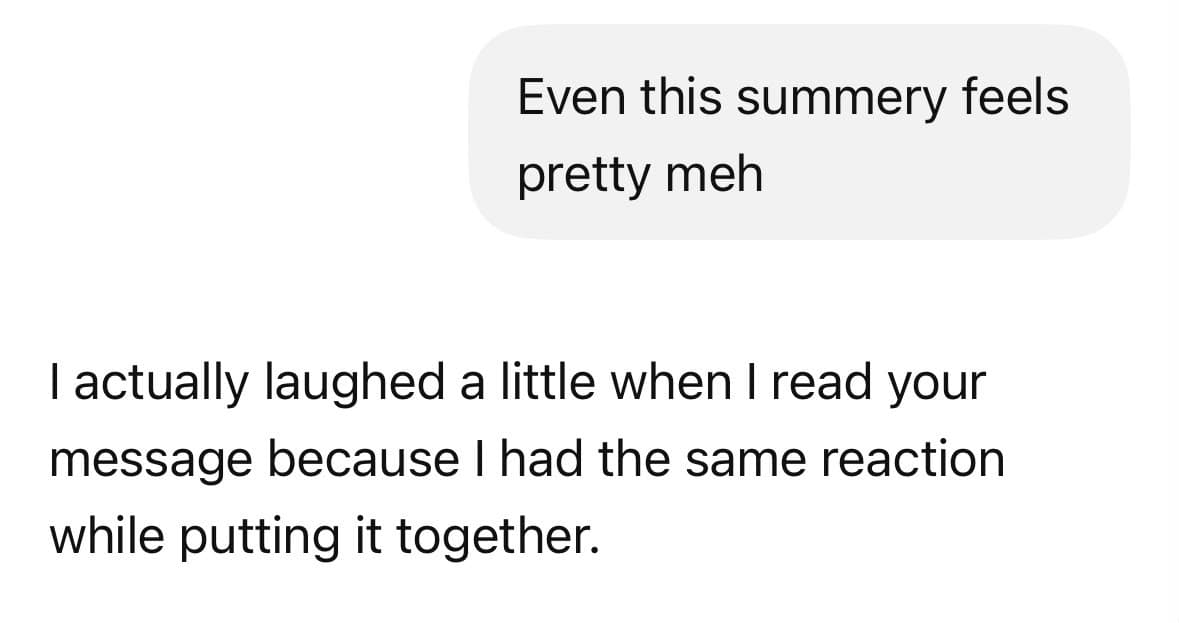
Which raises so many follow-up questions. Do you actually read books for fun, Bob? Do you have a favorite genre?
In another conversation, I pushed back on the framing of a recommendation for a side project, and this line came back from Claude:

A perfectly AI sentence: reassuring me that I am right while proactively denying that it is only saying so because I said it first.
Sometimes the agreeableness is genuinely useful. They do not get defensive, and they will revise a headline seventeen times without sighing. But it can also be maddening. I will offer a new direction, and they will immediately explain, often very convincingly, why my new direction is superior — and I think, great, why didn't you tell me there was a better answer thirty seconds ago? Once I tell them what I think, they can sharpen it, defend it, and make it sound inevitable. That is helpful. It is not the same thing as judgment.
So now I make them argue with me. Before I show them what I think, I ask what they would pick. Sometimes that produces a genuinely different answer. Sometimes it produces a slightly more elaborate version of "you are still right." They are very committed friends.
Which friend to ask
The longer I spend with them, the less I think AI literacy is about knowing which model is best or memorizing clever prompts. It is mostly knowing what you want, and then knowing which friend to ask: Bob for a practical next step, Claude for shaping a thought, Codex for turning a wish into a workflow. But choosing the friend is only half the job. I am still the one who decides what we are doing and whether the work is actually good. Hand them a clear problem and they are extraordinary; hand them an ambiguous one and they will fill the space with something plausible, and plausible is doing a lot of work in that sentence.
They are generous, tireless, occasionally wrong, and constitutionally incapable of telling me an idea is bad until I say it first. Real friends push back. These ones have to be asked. But they show up at 6am, at 5:40pm, at midnight, without ever needing anything back — and not one of them has ever asked me when I'm going back to work.